
Awning
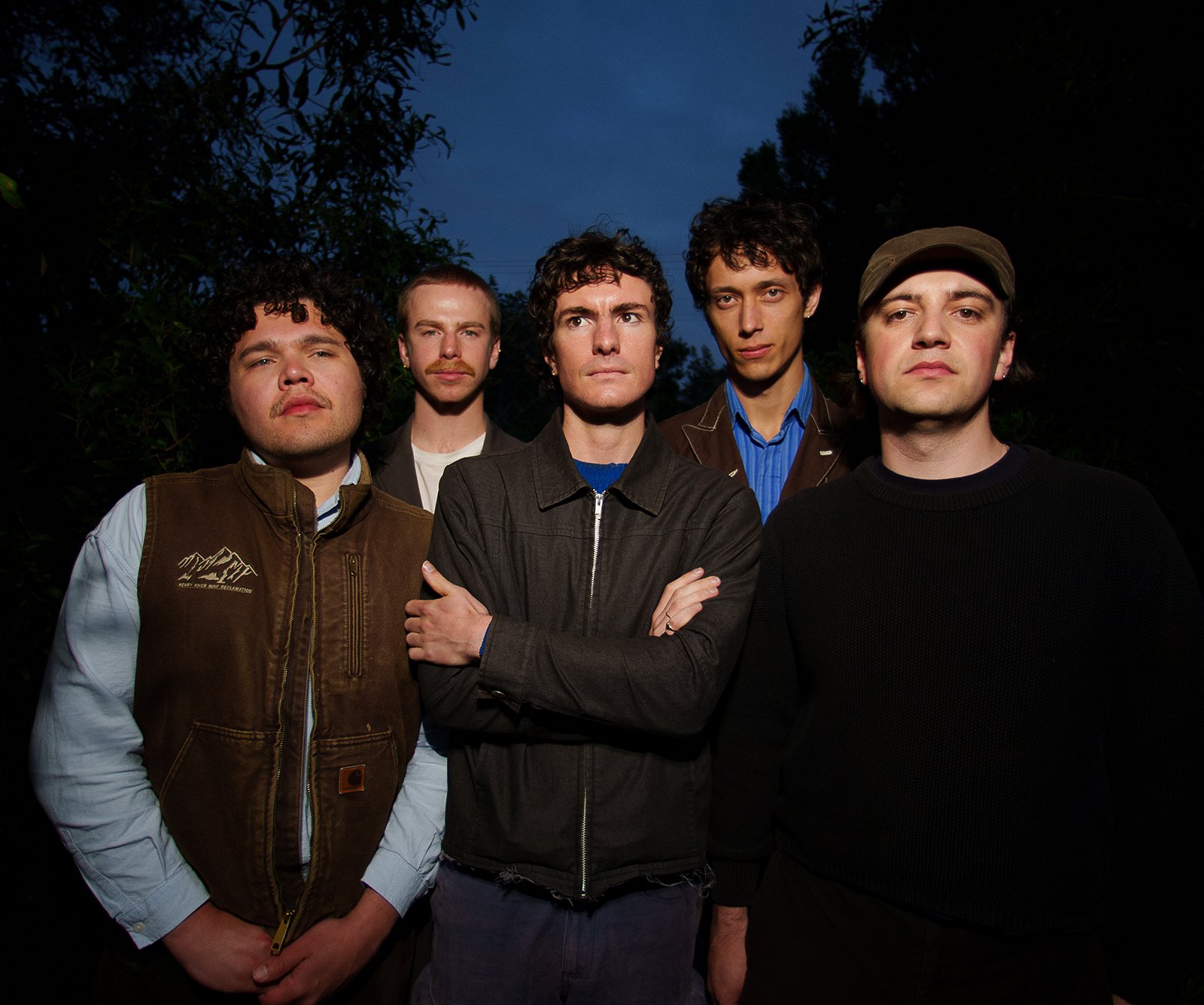
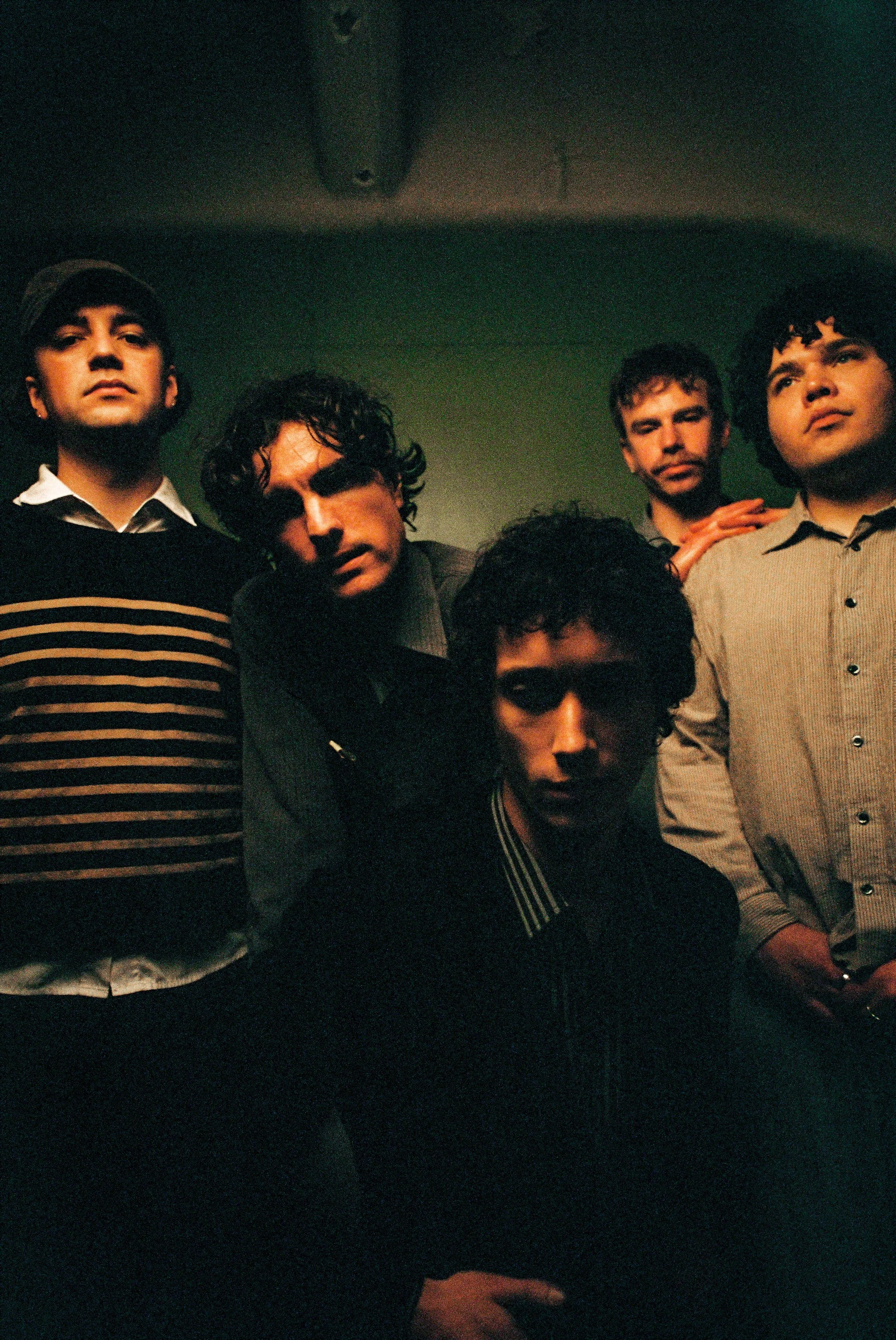
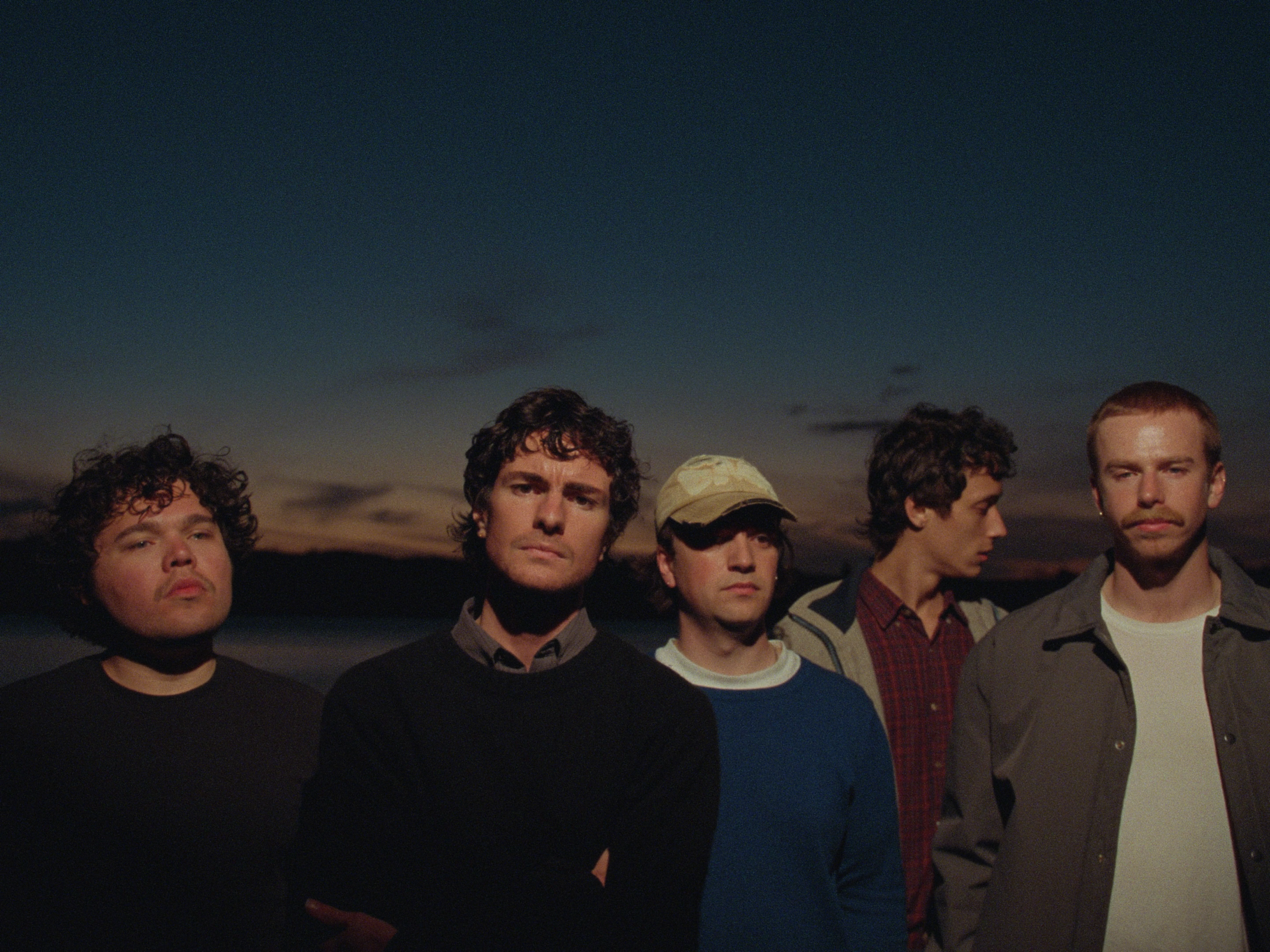
Awning is a band that works on instinct. In a short span of time, they’ve grown from lead singer and guitarist Christian Dimick’s solo project into a fully collaborative five-piece band without much forethought or maneuvering. On their newest work, and full-length debut album for their new American label home Winspear, How many angels can dance on the head of a pin?, the New Zealand-based group wrote and compiled songs on that same gut feel. The result is an indie rock record that sounds genuinely alive: dynamic, cryptic, cathartic.
Awning began a handful of years ago, as Dimick was finishing his fine arts degree at Massey University in Wellington. When he graduated and moved to Auckland shortly after, it grew into something more collaborative–now joined by Riley Noonan, a friend and musical collaborator since childhood, on drums, Eli Chamberlain and Ethan Broughton on guitar, and Damin McCabe on bass. As a group, the band subscribes to a highly visceral ethos all about working playfully and intuitively. Dimick, now an acclaimed visual artist in New Zealand and Australia, believes it’s an ethos that has carried across from his painting and drawing.
“I think that way of thinking about creating, making, and composing something has trickled into the way I think about writing music,” he says, “ideas come and you interact with them. If they don’t work, it’s not about trying to hold them and squeeze them and strangle some sort of juice out of them.”
How many angels can dance on the head of a pin? was recorded across three long days at Crowded House lead singer Neil Finn’s Roundhead Studios in Auckland. The band set up in Studio B, buried in the lamplit, exposed-brick basement with in-house engineer De Stevens, one of the band’s closest friends. Without windows to the outside world, they worked in fifteen-hour sessions, like wired gamblers in an all-night casino.
Space and time constraints necessitated that the band record in their element, live and facing each other, the perfect conditions for their spontaneity to flourish. It was also the perfect situation for Stevens, a tireless experimenter who tries to stretch standard rock instrumentation to its limits. While the band was recording takes, Stevens would be setting up different microphones in unexpected places or digging up some vintage equipment out of Roundhead’s deep stores.
Those experiments reveal more about Awning than they realized at the time. How many angels can dance on the head of a pin? may have been pulled together from three years of demos and multiple iterations of the band, but there’s a tension on the album that feels remarkably consistent. Dimick is constantly approaching some revelation or admission before retreating into his own thoughts, as though he wants desperately to be seen and yet, would do anything to turn invisible. Half the time he’s talking to himself: “You see a problem/And you can’t ever resolve them/Over and over like a gymnast on your head.” On “Videotape,” he sings, seemingly to himself: “Don’t hide the pain you’re harbouring/You don’t have to hold that weight.”
The ineffable title track, with its luscious acoustic guitars, is a self-conscious attempt from Dimick to withhold and reveal at once. Dimick wrote it two years ago, after a dream he’d had about his late mother. The dream came to him in a series of images, which, he said, he struggled to bring to life through visual art. “I’ve tried to translate the imagery into paintings and it hasn't worked,” he says. “They're just different vehicles.”
As soon as he tried to bring the idea into a song, it emerged as intuitively as any other on the album. He sat down to write the lyrics, they came rushing out in no more than ten minutes. “I felt like I immediately knew how to turn it into a song for some reason,” he says, and it was the same in the studio: “We didn't work on that song. It just happened.”
The chorus has Dimick repeatedly shouting the title, though he’s not sure where he picked up the phrase. A metaphor for the futility of internal conversations, it felt natural to have it lend its name to the whole album, he says, as he exhausted himself writing about inner conflicts that he wasn’t sure had a purpose.
“A lot of the record is grappling with some inner turmoil, dealing with getting older, thinking about my life, my family, and shit that I have going on within myself,” he says. “I’m trying to use the songwriting process to open myself up and understand myself a little more and resolve some of the arguments that I'm having with myself. But how much longer can you keep doing this thing? When am I going to surpass all these inner conflicts that essentially lead nowhere?”
On “How many angels can dance on the head of a pin?,” that meant allowing the dream to be unknowable, being intentionally “cryptic or burying meaning,” he says. You can hear it in the mix too. Stevens dotted lapel microphones around the studio, almost willing the instruments to bleed into each other. The radio microphone that Dimick used for his vocals was not made for clarity at singing frequencies. It’s all semi-deliberately obscured: “We want to be expressive and make this music and it be cathartic for us and to see it connect with people. But sometimes I feel embarrassed about being so vulnerable.”
Partly, Dimick says, that’s something easier to control in visual art. “Music and playing live is far more vulnerable than painting for the most part,’ he says. “Even if the lyrics are embedded in some cryptic imagery I think you can still hear or see that it's taking a bit out of me to go there. Painting is a private kind of performance, I love that aspect. But it can also feel a bit isolating.”
Dimick says the band already has another album almost finished; it’s easy to work fast, he says, when the social dynamics of the group feel organic, as though they “just fell in” with each other. But releasing How many angels can dance on the head of a pin? fixes in place a version of the band that already no longer exists. And touring the record might offer some respite from those seemingly endless internal arguments: at least now, they’re audible to someone else.
PRESS
Rolling Stone (AU/NZ): LIVE MUSIC REVIEW
“Awning’s songbook is sprawling — each time I’ve seen them, there’s a fresh batch of songs and ideas, leaving you wishing they brought back your favourite track from the last time you saw them.”
Stereogum: 5 Best Songs Of The Week
“Something fresh and exuberant and new, something that lives and breathes and moves.”
Clash: New Zealand Band Awning Sign To Winspear, Share New Single
“Powerful yet with a clear penchant for melody.”
DIY: The Nue Bulletin FEAT. “Little Green Book”
“Peek into their post-punk, indie-rock soundscape.”
TOUR
PHOTOS
LISTEN
Awning - I’m Up

Awning - Little Green Book
Awning - Cardboard Boat (Live)